


Produced water volumes are projected to increase 33% over the next decade as rising formation pressures affect disposal capacity and infrastructure planning.
Produced water volumes in the Permian Basin are expected to increase over the next decade, while rising formation pressures reduce the disposal capacity available through existing wells. The combination is expected to increase demand for new disposal infrastructure, transportation networks and recycling.
According to B3 Insight’s 1H 2026 Permian Water Market Outlook, produced water volumes are projected to rise from 21.8 million barrels per day in 2025 to 29.1 million by 2036, an increase of 33%. The outlook varies considerably between the Delaware and Midland basins, where differences in formation pressure, injection activity and available capacity will influence future infrastructure requirements and water management costs.
Delaware Basin Faces Growing Disposal Constraints
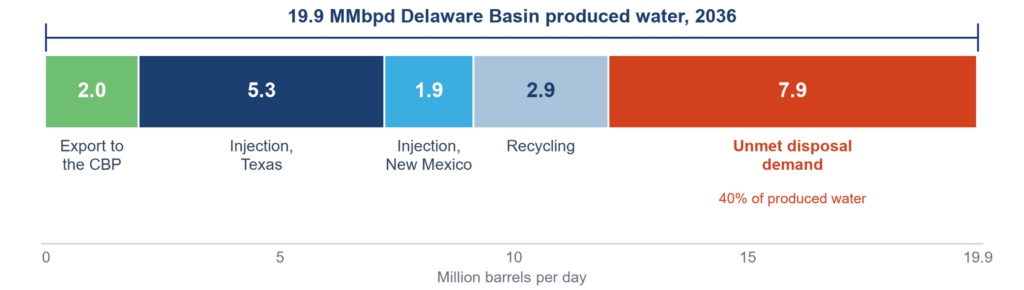
The Delaware Basin accounts for much of the projected growth, with B3 forecasting produced water volumes to increase from 14.0 million barrels per day in 2025 to 19.9 million by 2036.
At the same time, increasing formation pressures are expected to reduce operational disposal capacity at existing wells from 18.5 million barrels per day to 8.1 million by 2036.
B3 projects that disposal demand will exceed available capacity beginning in 2029, with the shortfall reaching 7.9 million barrels per day by 2036.
The projected imbalance has implications for where new disposal wells can be developed, how water is transported and the cost of managing future volumes.
Infrastructure Spending Expected to Increase
An estimated $5 billion to $6 billion in capital investment will be needed for Delaware Basin disposal wells and long-haul transportation infrastructure through 2036, according to B3’s analysis.
As disposal capacity becomes more constrained in certain areas, water midstream companies and operators will need to evaluate additional disposal locations, pipeline connections and transportation distances.
These changes could also affect operating expenses and the economics of water management across the Permian.
Recycling Growth Will Offset Some Disposal Demand
Produced water recycling is expected to expand alongside continued drilling and completion activity.
By 2036, B3 forecasts recycled water volumes will reach 6.8 million barrels per day, enough to supply approximately 95% of hydraulic fracturing water demand.
Even at that level, recycling would account for approximately 23% of total produced water volumes. Disposal is therefore expected to remain the primary management method for much of the water produced across the basin.
Midland Basin Maintains Capacity, With Localized Constraints
Conditions in the Midland Basin differ from those in the Delaware. Although the basin is expected to maintain substantial disposal capacity overall, injection activity is concentrated among a relatively small number of wells.
B3’s analysis finds that approximately 10% of active disposal wells account for 37% of injection volumes.
This concentration, along with localized formation pressure conditions, could affect disposal availability in individual areas despite sufficient capacity at the basin level.
Implications for Long-Term Water Planning
The forecasts indicate that subsurface conditions will play an increasingly important role in determining where disposal capacity remains available and where additional infrastructure may be required.
For operators, water midstream companies and investors, geographic differences in disposal capacity, pressure trends and infrastructure requirements will influence long-term water management costs and investment decisions.
Explore the Permian Water Market Outlook
B3 Insight’s 1H 2026 Permian Water Market Outlook provides detailed forecasts and analysis of produced water volumes, disposal capacity, formation pressure, recycling and infrastructure investment through 2036.
The analysis draws on B3 Insight’s integrated water and subsurface data, including regulatory filings, well permits, completion records, OilfieldH2O injection and production data, and InjectIQ reservoir modeling.