

Denver, CO – March 31, 2026 — B3 Insight today announced the launch of InjectIQ, an AI-enabled forecasting software tool designed to model produced water volumes, saltwater disposal capacity, and subsurface reservoir pressure across the Permian Basin.
Produced water is now a defining factor in Permian cost structure and operational planning. Rising water volumes, tightening disposal capacity, and increasing formation pressures are contributing to higher operating costs, shifting infrastructure requirements, and widening differences in asset-level performance across the basin.
For E&P operators, these dynamics affect drilling inventory quality, AFE accuracy, and the risk of production curtailments tied to water constraints. For water midstream companies, they shape unit economics and capital deployment decisions tied to pipeline development and long-term disposal capacity.
InjectIQ was developed to provide forward-looking visibility into these conditions by combining basin-scale forecasting with B3 Insight’s proprietary dataset of produced water volumes, injection activity, and subsurface pressure. This integrated approach enables teams to evaluate future constraints using a consistent, data-grounded view of how water systems and reservoir conditions evolve over time.
“Produced water and subsurface pressure are now directly influencing cost, development timing, and asset performance across the Permian,” said Kelly Bennett, CEO of B3 Insight. “Operators and midstream companies need a clear view of how these conditions, how they are changing and what that means for future operations.
“InjectIQ extends the data our clients rely on into an AI-powered forecasting environment, allowing teams to assess disposal capacity, pressure risk, and infrastructure needs with a higher degree of confidence as conditions evolve.”
Forecasting the Future of Water Management
InjectIQ integrates production forecasting, water transportation modeling, and reservoir pressure simulation to provide a well-to system-wide view of water across the basin. The software models produced water across time and geography, tracks how volumes move through disposal networks, and simulates how injection influences formation pressure and available pore space for disposal. It identifies areas that are most at risk for environmental or regulatory concerns.
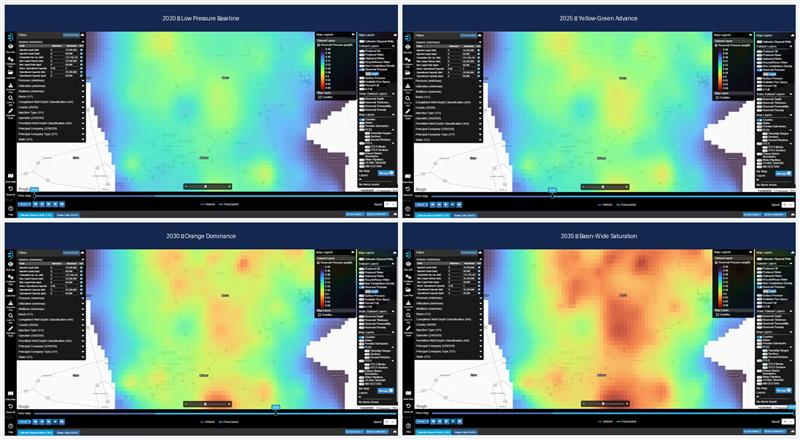
Scenario modeling capabilities allow technical teams to test assumptions around drilling activity, infrastructure and disposal strategies, and regulatory changes—supporting more informed planning across both operations and capital allocation.
Built on Industry Expertise
InjectIQ was developed in collaboration with a group of industry adopters who provided technical input throughout the software’s development. The cohort includes several large Permian operators whose engineering and planning teams helped refine forecasting workflows, model assumptions, and user functionality.
“We are grateful to the operators who partnered with us throughout development,” said Patrick Patton, Vice President of Product Management at B3 Insight. “Their collaboration over the last year ensured that InjectIQ reflects real-world operating conditions and geoscience to support their disposal strategies, pressure management, and long-term planning.”
Strategy for Future Permian Development
Permian Basin water production will continue to grow by over 30% in the next decade, increasing demands on transportation and disposal infrastructure. As disposal formation pressures rise and regulatory oversight expands, the ability to anticipate future conditions is critical to maintaining operational continuity and managing costs.
InjectIQ provides a forward-looking view of these dynamics, enabling operators and midstream companies to plan development, infrastructure, and water management strategies with greater clarity. Learn more at b3insight.com/injectiq.
About B3 Insight
B3 Insight is a data and analytics company focused on one of the most consequential drivers in U.S. unconventional energy today, water. The company provides proprietary datasets, software platforms, and water intelligence; giving operators, midstream companies, investors, and regulators a clearer view of how produced water can impact operational and strategic decisions.