


This article is a summarized and edited version of a piece originally written by Pat Patton, published on Substack in May 2026.
The Permian’s growing produced water volumes are pushing the limits of subsurface injection.
A Closed System Problem
The Permian Basin produces oil, gas, and water at scale, and while oil and gas move into markets, produced water largely moves back underground through a system of gathering lines, pipelines, recycling operations, and salt water disposal wells (SWDs) that return most of it to the same closed oilfield loop it came from.
Produced water volumes grow with production, increasing as new wells come online, as older wells cut more water, and as the Permian continues to carry a disproportionate share of the American oil supply. Unless production declines materially, it compounds across the basin.
The basin’s infrastructure, contracts, and regulatory frameworks were built around SWDs as the primary outlet because injection capacity has historically been considered available, scalable, and comparatively low cost than alternatives.
What Injection Does and Does Not Do
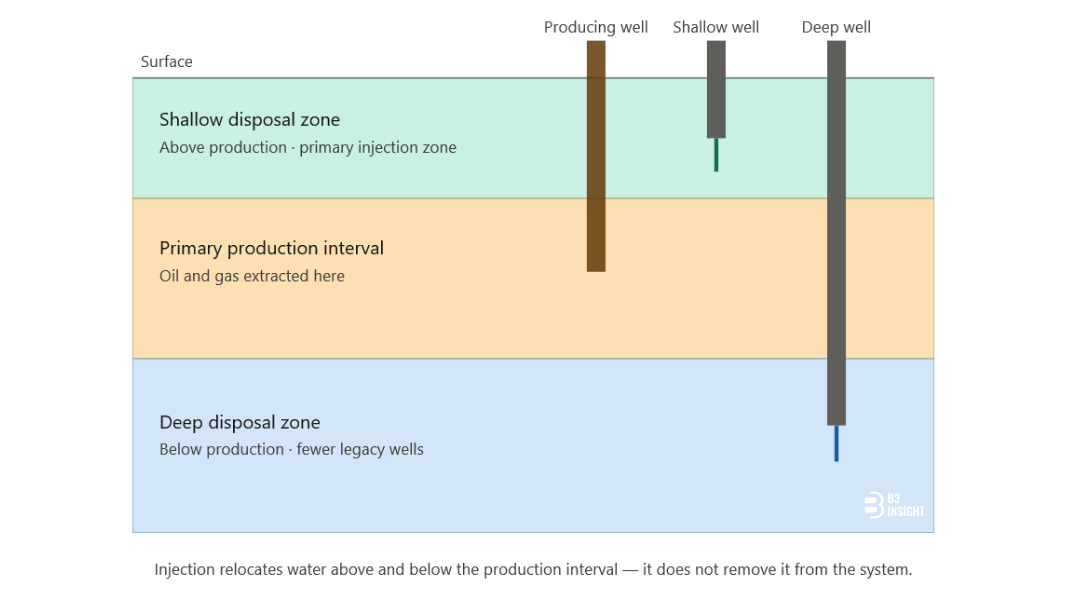
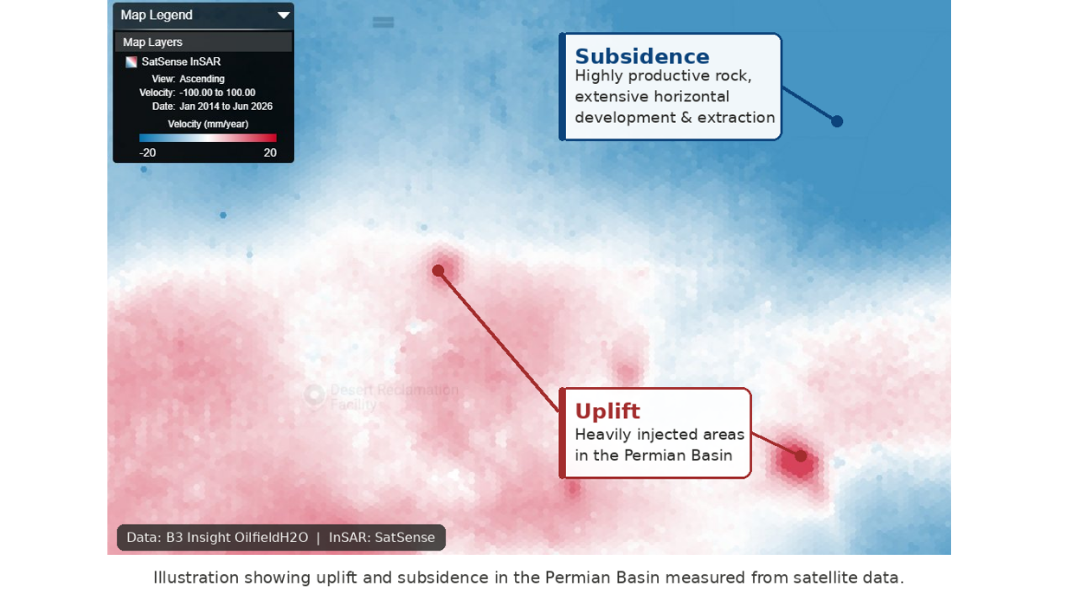
Injection relocates water within the subsurface rather than removing it from the oilfield system, and when disposal volumes concentrate into receiving formations over time, the geological response is predictable. In some cases, the ground surface moves upward, swelling from the large volumes of produced water injection. In other cases, the ground surface subsides in areas where hydrocarbon extraction is expensive. In nearly all areas where injection has been concentrated for prolonged periods of time, formation pressure builds, injectivity declines, available capacity tightens, operational risk increases, and regulatory response follows. This dynamic reflects the behavior of a system designed to move water rather than eliminate it.
 Recycling: Useful but Incomplete
Produced water recycling has expanded meaningfully across the Permian, and a barrel recycled into a new completion reduces stress on SWD capacity, lowers freshwater demand, and improves operational flexibility by deferring disposal volumes. Those benefits are real and operationally significant. However, unless water is permanently removed from the oilfield loop, it eventually returns, often saltier and more chemically complex than when it entered, leaving the long-term destination question unresolved.
The Distinction That Matters
Treated discharge and evaporation differ from injection and recycling in one structural way: both remove water from the oilfield cycle rather than returning it to the subsurface. Discharge produces concentrated brine as a byproduct that requires further management, and evaporation carries cost, land use, and public acceptance challenges, so neither pathway is simple or immediately scalable. The relevant test for any produced water approach is whether it removes water from the cycle or relocates it within the cycle, because that distinction determines the long-term trajectory of disposal capacity and formation pressure challenges across the basin.
The Legacy Wellbore Risk
The Permian has been drilled for more than a century, and hundreds of thousands of wellbores penetrate the subsurface, many of them old, poorly documented, or drilled before modern standards existed. Some of those wellbores intersect formations now receiving large and growing volumes of injected water, representing potential migration pathways that are incompletely characterized across much of the basin. Deep injection zones generally have fewer legacy penetrations, which may reduce certain migration risks, but they also carry less subsurface characterization data, which limits the precision available for pressure management and risk assessment.
A Portfolio Approach
Managing produced water at scale requires multiple exit pathways operating in parallel: injection where geology, seismic risk, and formation capacity support it sustainably; recycling where it reduces freshwater demand and near-term disposal volumes; deep disposal where subsurface conditions and data allow; treated discharge where water can permanently exit the oilfield cycle; and evaporation where economics and land conditions permit. No single outlet is sufficient to carry the full load, and diversifying exit pathways reduces systemic risk across the basin in the same way the industry applies portfolio logic to other constrained resources.
If produced water can be treated to the standard required for use outside the oilfield, it functions as a net new water source in one of the most water-stressed regions in the United States, one that does not draw from an aquifer or compete with municipal or agricultural supply. The economics of treatment relative to disposal will continue to shift as regulatory restrictions on injection tighten and regional water competition intensifies, narrowing the gap between what disposal costs and what treatment enables.
Ultimately, “effective” produced water management in the Permian requires asking not only where water can be placed, but how much of it can be permanently removed from the oilfield cycle and at what pace that removal can be scaled.